Many people start playing poker believing that winning depends entirely on getting lucky cards. While luck does influence short-term results, poker is fundamentally a game of skill. Over time, players who consistently make better decisions outperform those who simply hope for favourable hands.
Developing a solid poker strategy for beginners is the first step towards becoming a successful player. Instead of chasing every pot or making emotional decisions, a strategic approach helps you understand when to play, when to fold, and how to maximise value from strong hands while minimising losses with weaker ones.
The best poker players spend years refining their decision-making process. Fortunately, beginners do not need advanced mathematical models or professional-level experience to improve. Learning the core principles can dramatically increase your chances of winning and help you avoid the most common mistakes that inexperienced players make.
Whether you enjoy online poker, private cash games, or live tournaments, building a strong strategic foundation allows you to make informed decisions at every stage of a hand.
Understanding the Basics Before Building a Winning Poker Strategy
Before focusing on advanced concepts, every player should fully understand the game’s fundamentals. Strategy becomes effective only when it is built on a clear understanding of poker mechanics.
You should become comfortable with:
- Poker hand rankings
- Betting rounds
- Blind structure
- Position at the table
- Pot odds basics
- Player actions
- Betting terminology
Many beginners skip these basics because they appear simple. However, misunderstanding even one of these concepts often leads to costly mistakes.
The strongest players never ignore fundamentals. Instead, they continuously improve their understanding of the game’s mechanics.
Learn Why Position Is One of the Biggest Advantages in Poker
Position refers to where you are seated relative to the dealer button. It is one of the most important concepts in poker because it determines the order in which players act.
Players acting later receive more information since they can observe how opponents behave before making decisions.
Generally, table positions include:
Early Position
Players in early position should play cautiously because many opponents still have an opportunity to act.
Middle Position
Players gain slightly more flexibility but should still avoid unnecessary risks.
Late Position
This is often considered the strongest position because players have maximum information before making decisions.
Playing more hands in late position and fewer hands in early position is one of the simplest adjustments that can significantly improve long-term results.
Start With Strong Starting Hands Instead of Playing Everything
One of the biggest mistakes beginners make is entering too many pots.
Not every hand deserves to be played.
Professional players fold most of their starting hands because waiting for stronger opportunities increases profitability over time.
Some examples of premium starting hands include:
- Pocket Aces
- Pocket Kings
- Pocket Queens
- Ace-King suited
- Ace-Queen suited
Medium-strength hands should usually be played depending on position and table dynamics.
Weak hands often appear tempting because they occasionally create surprising combinations. However, consistently playing poor starting hands usually results in long-term losses.
Understand Why Folding Is Often the Best Decision
Many beginners feel disappointed whenever they fold.
Experienced players understand that folding saves money.
Every chip saved during a weak situation becomes available for stronger opportunities later.
Learning to fold confidently is a major milestone in becoming a disciplined poker player.
Ask yourself:
- Is my hand likely to improve?
- Does my opponent represent significant strength?
- Am I calling simply because I have already invested chips?
- Does continuing make mathematical sense?
If the answer is no, folding is often the correct play.
Avoid Emotional Decisions and Stay Mentally Disciplined
Poker challenges emotional control more than almost any other competitive game.
Bad beats happen.
Strong hands lose.
Bluffs fail.
Unexpected outcomes occur regularly.
Successful players remain calm regardless of short-term results.
Emotional decision-making often leads to:
- Revenge betting
- Calling without logic
- Overplaying weak hands
- Ignoring bankroll limits
- Making impulsive bluffs
Maintaining emotional discipline protects your bankroll and improves decision quality.
Learn to Read Opponents Instead of Focusing Only on Your Own Cards
Poker is a game of incomplete information.
Your cards represent only one part of the equation.
Observing opponents provides valuable insights into their likely holdings.
Look for patterns such as:
Betting Frequency
Do they bet aggressively on every street?
Reaction Time
Do they act instantly or hesitate before betting?
Bluffing Habits
Are they capable of bluffing frequently?
Showdown Tendencies
Do they reveal strong hands consistently, or are they often bluffing?
Over time, identifying these behavioural patterns helps you make more profitable decisions.
Master the Art of Bankroll Management
Even excellent poker players experience losing sessions.
Without proper bankroll management, temporary losses can eliminate your ability to continue playing.
A responsible bankroll strategy involves:
- Never risking your entire bankroll in one session
- Choosing games appropriate for your bankroll size
- Avoiding emotional attempts to recover losses
- Tracking wins and losses consistently
Professional players treat bankroll management as seriously as strategic decision-making.
Understand Pot Odds and Expected Value Without Making It Complicated
Many beginners become intimidated when hearing mathematical poker concepts.
Fortunately, basic understanding is enough to improve significantly.
Pot odds compare:
- The amount required to call
- The total pot available
Expected value estimates whether a decision will be profitable over many repetitions.
Rather than focusing on immediate outcomes, experienced players evaluate whether their decision is correct mathematically.
This long-term perspective separates winning players from losing ones.
Bluff Selectively Instead of Bluffing Frequently
Movies often portray poker as a game filled with dramatic bluffs.
Reality is very different.
Most successful players bluff selectively.
Good bluffing requires:
- Credible betting patterns
- Suitable board texture
- Appropriate opponent selection
- Awareness of stack sizes
Beginners should prioritise value betting over excessive bluffing.
Winning with strong hands consistently is more profitable than attempting risky bluffs every session.
Learn How Different Poker Formats Require Different Strategies
Not every poker game follows the same strategic principles.
Cash Games
Chip values remain constant, allowing players to buy back into games after losses.
Sit-and-Go Tournaments
Increasing blinds require players to become progressively more aggressive.
Multi-Table Tournaments
Survival becomes increasingly important as payouts approach.
Home Games
Friendly environments often encourage looser play styles, requiring strategic adjustments.
Understanding format-specific differences helps beginners adapt more effectively.
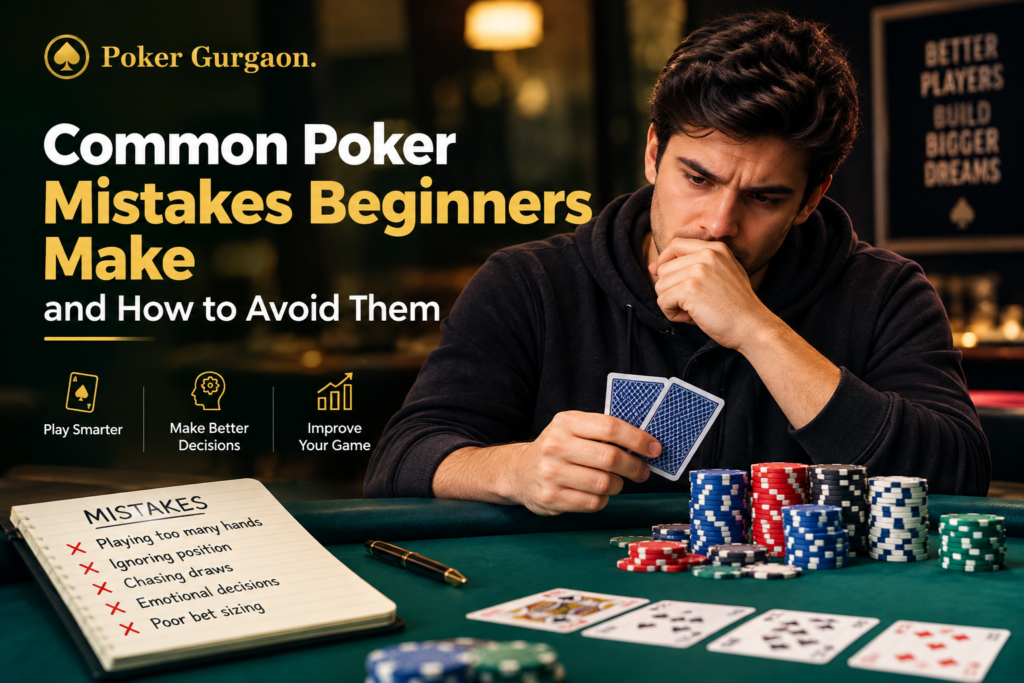
Recognise the Most Common Beginner Mistakes
Improvement begins by eliminating avoidable errors.
Common mistakes include:
- Playing too many starting hands
- Ignoring position
- Bluffing excessively
- Chasing unlikely draws
- Calling without a plan
- Playing emotionally
- Overvaluing one pair
- Ignoring bankroll management
- Refusing to fold
Correcting these habits often produces immediate improvements.
Build a Consistent Practice Routine to Improve Faster
Poker is a skill developed through deliberate practice.
A productive learning routine may include:
- Reviewing previous sessions
- Studying professional hand analyses
- Watching educational strategy content
- Practising decision-making rather than memorising moves
- Tracking performance statistics
- Discussing hands with experienced players
Continuous learning helps players avoid stagnation and steadily improve over time.
Choosing the Right Environment to Develop Your Skills
Beginners often improve faster when playing in comfortable environments where they can focus on learning instead of feeling pressured.
Many players enjoy casual sessions before moving into more competitive settings. Friendly games allow you to experiment with strategies, understand betting patterns, and gain confidence while making fewer costly mistakes. If you are looking for organised local experiences, exploring Poker in Gurgaon can help you discover venues where players of different experience levels regularly participate. As your confidence grows, combining practical experience with strategic study accelerates long-term improvement.
Practising With Friends Can Strengthen Your Decision-Making Skills
Playing regularly is one of the fastest ways to gain experience, especially when the environment encourages discussion and learning.
Many new players organise poker home games Gurgaon to practise reading opponents, managing chips, and experimenting with different betting strategies without the pressure of large buy-ins. These games create opportunities to analyse hands after each session, helping players understand why certain decisions succeed while others fail. Constructive feedback from fellow players can often be just as valuable as studying strategy guides.
Exploring Different Live Poker Experiences
Once you have mastered the fundamentals, experiencing different poker environments can broaden your understanding of the game.
Many players choose to participate in Poker Games in Delhi because they offer exposure to varied playing styles, table dynamics, and competitive situations. Facing new opponents helps beginners develop adaptability, improve observation skills, and become more confident when making decisions under pressure. Combining live experience with continuous learning creates a balanced path toward becoming a stronger poker player.
Long-Term Success Comes From Better Decisions, Not Better Luck
Every successful poker player experiences both winning and losing sessions.
The difference lies in consistently making profitable decisions rather than relying on favourable cards.
By focusing on position, starting hand selection, bankroll management, emotional discipline, opponent observation, and continuous learning, beginners can dramatically improve their performance over time.
The goal should never be to win every hand.
Instead, aim to make the best possible decision in every situation. Over hundreds and thousands of hands, disciplined decision-making consistently outperforms luck and builds lasting success.
Conclusion
Learning poker is a journey that rewards patience, discipline, and continuous improvement. While luck may influence individual hands, long-term success depends on making consistently smart decisions. By mastering the fundamentals, understanding position, selecting strong starting hands, managing your bankroll responsibly, and staying emotionally disciplined, beginners can develop the confidence needed to compete effectively. The more you study the game and analyse your decisions, the stronger your skills will become. Remember that every experienced poker player started as a beginner, and with the right approach, you can steadily transform your knowledge into consistent results at the table.
FAQs
What is the most important poker strategy for beginners?
The most important strategy is to play fewer but stronger starting hands, understand table position, avoid emotional decisions, and focus on making mathematically sound choices rather than relying on luck.
How long does it take to become good at poker?
The learning curve varies for every player. With regular practice, studying strategy, reviewing previous hands, and maintaining discipline, most beginners notice significant improvement within a few months.
Should beginners bluff often?
No. Beginners should focus on value betting and learning solid fundamentals before attempting frequent bluffs. Successful bluffing requires experience, proper timing, and a good understanding of opponents.
Why is position so important in poker?
Position allows you to observe your opponents’ actions before making your own decision. Acting later provides more information, leading to better decision-making and improved long-term profitability.
Is bankroll management necessary for casual players?
Yes. Regardless of skill level, proper bankroll management helps prevent unnecessary losses, allows you to continue playing during losing streaks, and encourages responsible decision-making.
Can I improve by playing home games?
Absolutely. Friendly home games provide an excellent environment to practise strategies, learn from mistakes, and gain confidence before participating in more competitive games.
How can I avoid common beginner mistakes?
Study the fundamentals, review your gameplay regularly, avoid playing too many hands, respect table position, remain emotionally disciplined, and continue learning from experienced players.