Many beginners immediately search for winning tactics without first understanding how poker functions. Before exploring advanced concepts, every player should become familiar with the structure of the game, betting rounds, and hand rankings.
Poker is played in multiple variations, but Texas Hold’em remains the most popular format worldwide. Players receive private cards, community cards are dealt on the table, and the objective is to make the strongest five-card poker hand or force opponents to fold before showdown.
Learning the flow of each hand is equally important. Every decision you make during the pre-flop, flop, turn, and river affects your long-term profitability. Understanding these stages provides the framework needed to make logical betting decisions instead of relying on instinct.
If you are completely new to the game, reviewing the basic texas holdem rules before playing real-money games will help you understand betting order, blinds, community cards, and winning hand combinations.
Learn Every Poker Hand Ranking Before Playing
A surprising number of beginners lose because they misread their hands. Knowing poker hand rankings instantly helps prevent costly mistakes.
From strongest to weakest, the standard ranking is:
Royal Flush
The highest possible hand consisting of A, K, Q, J, and 10 of the same suit.
Straight Flush
Five consecutive cards of the same suit.
Four of a Kind
Four cards sharing the same rank.
Full House
Three matching cards plus a separate pair.
Flush
Five cards of the same suit regardless of sequence.
Straight
Five consecutive cards that may belong to different suits.
Three of a Kind
Three cards sharing the same rank.
Two Pair
Two separate matching pairs.
One Pair
Two cards of identical rank.
High Card
When no player forms any of the above combinations, the highest individual card determines the winner.
Understanding these rankings should become second nature before joining any cash game or tournament.
Start With Premium Hands Instead of Playing Every Deal
One of the biggest mistakes beginners make is playing too many starting hands. Every hand may appear exciting, but most are statistically unprofitable.
Professional players fold far more hands than they play. Patience is one of the strongest weapons in poker.
Strong starting hands generally include:
- Pocket Aces
- Pocket Kings
- Pocket Queens
- Ace-King
- Ace-Queen suited
- Pocket Jacks
- Ace-Jack suited
Weak hands such as unsuited low cards or disconnected cards often create difficult post-flop situations.
Waiting for quality starting hands helps reduce difficult decisions and protects your bankroll from unnecessary losses.
Why Position Matters More Than Most Beginners Realise
Position refers to where you act during each betting round.
Players acting later gain valuable information because they observe how opponents behave before making their own decisions.
The table generally consists of:
Early Position
Players must act first with minimal information. Stronger starting hands are recommended.
Middle Position
Offers slightly more flexibility but still requires disciplined hand selection.
Late Position
Usually the Button and Cutoff.
Late position provides several advantages:
- More information before acting
- Better bluffing opportunities
- Improved pot control
- Ability to steal blinds more effectively
- Greater overall profitability
Many winning players attribute a significant portion of their success to consistently taking advantage of positional awareness.
Understand Betting Rather Than Simply Calling Every Time
Calling every bet may feel safe, but passive poker rarely produces consistent profits.
Each betting option serves a strategic purpose.
Fold
Discard an unprofitable hand and preserve chips.
Check
Pass the action without investing more chips when permitted.
Call
Match the current wager.
Bet
Initiate action when no previous bet exists.
Raise
Increase the current wager to apply pressure or build the pot.
Beginners often call too frequently because they fear folding the winning hand. Experienced players recognise that folding weak holdings saves money over thousands of hands.
Learn to Observe Opponents Instead of Only Watching Your Cards
Poker is ultimately a game played against people rather than cards.
Watching your opponents can reveal valuable information including:
- Betting frequency
- Bluff tendencies
- Aggression level
- Emotional reactions
- Stack management
- Timing patterns
Even online players display behavioural patterns through bet sizing and decision speed.
Developing observational skills early creates a significant long-term advantage.
Build a Solid Poker Strategy Instead of Depending on Luck
Many new players mistakenly believe winning depends on fortunate card distribution. In reality, consistent success comes from disciplined decision-making over thousands of hands.
A successful Poker strategy for beginners focuses on making mathematically sound choices rather than chasing unlikely outcomes. This includes selecting strong starting hands, respecting table position, avoiding emotional decisions, and understanding when folding is the most profitable option. Developing these habits early helps players minimise unnecessary losses while steadily improving their overall performance.
As experience grows, strategic thinking becomes more valuable than simply hoping for favourable cards.
Avoid Bluffing Too Frequently During Your Learning Phase
Bluffing is often glamorised through movies and televised tournaments.
In reality, professional players bluff selectively.
New players should bluff less because they often:
- Choose poor situations
- Bluff too many opponents
- Ignore betting patterns
- Overestimate fold equity
Instead of forcing bluffs, beginners should focus on value betting strong hands.
Winning consistently with solid fundamentals is more profitable than attempting elaborate bluffs.
Understand Pot Odds and Why They Matter
Pot odds compare the amount required to call with the potential reward.
Suppose:
- Pot contains $100
- Opponent bets $25
- You call $25 to win $125
These odds help determine whether calling is mathematically correct.
Although beginners do not need advanced calculations immediately, understanding the concept helps eliminate emotional decision-making.
As your experience grows, pot odds become one of the most valuable analytical tools in poker.
Protect Your Bankroll Like a Professional
Bankroll management separates recreational players from disciplined competitors.
Never risk money you cannot afford to lose.
General recommendations include:
- Play within your budget
- Avoid chasing losses
- Move down in stakes after losing sessions
- Maintain dedicated poker funds
- Track wins and losses regularly
Even world-class professionals experience losing streaks.
Effective bankroll management ensures those inevitable downturns do not end your poker journey.
Control Your Emotions Throughout Every Session
Emotional decision-making destroys more bankrolls than poor cards.
Common emotional mistakes include:
Tilt
Playing recklessly after losing.
Revenge Gambling
Trying to recover losses immediately.
Overconfidence
Increasing stakes after short winning sessions.
Maintaining emotional discipline helps players make consistent decisions regardless of recent outcomes.
Taking breaks after difficult sessions often improves long-term results.
Practice With Low-Stakes Games Before Playing Bigger Events
Many beginners jump directly into expensive tournaments.
This approach usually leads to avoidable losses.
Instead:
- Play micro-stakes cash games
- Join beginner-friendly tournaments
- Review completed hands
- Study mistakes regularly
- Track statistical performance
Gradual improvement produces far better long-term results than rushing toward higher limits.
Learn From Strong Poker Communities and Trusted Resources
Improvement becomes much easier when you engage with experienced players and reliable educational platforms. Reading strategy articles, reviewing hand histories, and discussing difficult situations can help accelerate your learning curve.
If you are looking for a trusted poker community in India, poker cyber city has built a reputation among players seeking organised games and a competitive environment. Studying how experienced players approach different situations can provide valuable insights that complement your own practice sessions.
Combining practical experience with continuous learning is one of the fastest ways to become a stronger player.
Practice Consistently Before Focusing on Results
Poker rewards long-term consistency rather than short-term outcomes.
A player making correct decisions can still lose individual hands due to variance.
Judge your progress based on:
- Decision quality
- Hand selection
- Positional awareness
- Emotional discipline
- Bankroll management
- Strategic improvement
Over time, these factors produce sustainable success.
Why PokerGurgaon Is a Valuable Resource for Indian Poker Players
Learning poker becomes much easier when you have access to trustworthy educational content and a community focused on improving player knowledge. PokerGurgaon has established itself as a recognised platform for poker enthusiasts looking to stay informed about poker rooms, tournaments, strategy guides, industry news, and responsible gaming practices.
Whether you are researching different poker formats, comparing playing options, or expanding your understanding of the game, PokerGurgaon provides valuable insights that can support your growth as a player. Combining educational resources with regular practice helps beginners build confidence while avoiding many of the common mistakes that slow progress.
Continue Improving Beyond the Fundamentals
The basics are only the beginning of your poker journey. As your understanding grows, you can gradually explore advanced concepts such as range analysis, expected value calculations, exploitative play, Game Theory Optimal (GTO) strategies, blocker effects, and tournament-specific adjustments.
However, none of these advanced concepts replace strong fundamentals. Players who consistently master starting hand selection, positional awareness, disciplined betting, bankroll management, and emotional control usually outperform those who skip directly to advanced strategies.
Even experienced professionals continue reviewing hands, studying opponents, and refining their approach because poker is a game of continuous learning.
Conclusion
Becoming a successful poker player does not happen overnight. It begins with understanding the fundamentals, making disciplined decisions, and developing habits that remain profitable over thousands of hands. Patience, position, bankroll management, and emotional control are often more important than spectacular bluffs or lucky cards.
Whether you are playing casual games with friends or preparing for competitive tournaments, focusing on poker basics for beginners provides a solid foundation for long-term improvement. Continue practising, analyse your mistakes, learn from experienced players, and gradually build your skills. With dedication and consistent study, every session becomes an opportunity to become a smarter and more confident poker player.
Frequently Asked Questions
What is the best poker game for beginners?
Texas Hold’em is generally considered the best starting point because its rules are straightforward, educational resources are widely available, and most online and live poker rooms offer beginner-friendly games.
How many starting hands should beginners play?
New players should play fewer hands and focus on premium starting combinations. Folding weak hands before the flop reduces difficult situations and improves long-term results.
Is poker mostly luck or skill?
Luck influences individual hands, but skill determines long-term success. Players who consistently make better decisions will generally outperform less disciplined opponents over time.
How much money should a beginner risk?
Only play with money you can comfortably afford to lose. Establish a separate poker bankroll and avoid using funds intended for essential expenses.
How long does it take to become a good poker player?
The learning process varies depending on study habits and playing frequency. Players who regularly review hands, practise consistently, and study strategy often improve much faster than those who rely solely on experience.
What is the biggest mistake new poker players make?
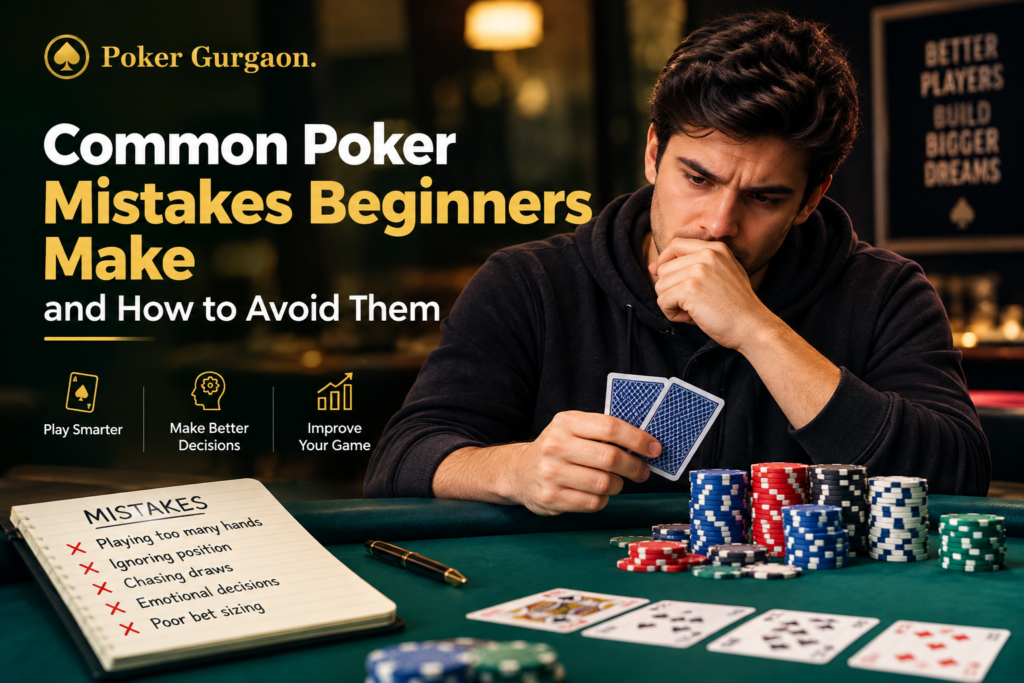
Playing too many starting hands, ignoring table position, chasing losses, and making emotional decisions are among the most common mistakes beginners should avoid.